Sunday, April 21, 2013

Potaje de Vigilia -- A Spanish Lenten potage


Although this recipe is good for cold weather and famous during Lent in Spain, I am posting it now on a warm, sunny spring day three weeks after Easter.  A student told me about this recipe last year during Lent, but I never got around to making it until this year.  I have to say that I am very grateful to him for passing this delicious idea on to me!

The potaje de vigilia is a dish that is eaten in Spain on Fridays during Lent as its principal ingredients are garbanzos, cod, and spinach.  The Spanish word potaje has the same origins as the English word 'potage' (or 'pottage'), which all come from the Old French word potage which refers to "that which is put into a pot."  The word in Spanish, as stated by the Royal Academy of the Spanish Language, is another word for a soup.  But this word is often used as an antonomasia and describes a soup made with legumes, vegetables, and other ingredients especially during periods of abstinence.  The word vigilia comes from the Latin word vigilĭa, and one of its meanings that I translate from Spanish is, "a meal with abstinence of meat," hence the term potaje de vigilia: a pot of soup eaten on days of abstinence.

The key ingredient in this pottage is another legume that I use quite often in my cooking: garbanzo beans (or chickpeas).  As these tasty legumes are not part of Midwestern American  fare, I never really started to eat them until I came to Spain.  Now I eat them a few times a month cooked in a variety of methods.  I recommend them to you because of their great nutritional value  they are high in protein and dietary fiber, and low in calories and fat.  Another benefit is that they are very filling, which is good for those of you who are dieting. 

If you choose to make this recipe, I recommend making variations according to the ingredients you have available.  It may be difficult to find salted cod, so just use fresh or frozen cod.  You could even use another white fish or leave out the fish entirely.  This healthy dish is sure to please you.  After following my instructions you can "buy something with" a mess of pottage.  Go ahead, take the challenge and follow the recipe I have provided below.  
Equipment
1 large pot
1 large bowl
1 medium bowl
1 medium frying pan
1 chopping knife
1 colander
1 wooden spoon

Ingredients
400 grams of dehydrated, salted cod (I don't know if this is available in the States, you might have to just use fresh white fish)
500 grams of dried garbanzo beans (chickpeas)
3 tomatoes
4 medium carrots
1 large onion, plus another half of an onion
400 grams of spinach (fresh or frozen)
4 whole cloves
1 head of garlic, plus 2 cloves
2 small bay leaves
Cumin
2 dry ñora peppers (I don't know if this is possible to find, so if not just use sweet paprika)
Salt
Pepper
4 hard-boiled eggs (optional)
Water


Instructions
1. Clean the garbanzos with warm water and look for imperfections.  Let them soak overnight (about 12 hours) in warm water and salt in a large bowl.  Make sure you use a large bowl because the beans almost double in size.


2. If using salted cod, rinse off salt in cold water.  Put it in a bowl with cold water and cover it.   Leave it in the refrigerator overnight.  Make sure to change the water at least three times.  (I had it in the water for a total of 15 hours)

3. Peel the carrots and cut each into 3 pieces and take the outer skin off of the garlic.  If using ñoras, take off the stem and remove the seeds.

4. Then peel the skin off of the onion.  Cut the top of the onion off.  Don't cut the bottom off, but cut the roots off to keep it clean and in tact.  Make four cuts in a cross form without cutting too deep.  Puncture the onion with the 4 cloves.  

5. Put the onion with cloves, garlic, carrots, and bay leaves into a large pot with about 2 liters of water and bring to a boil.  (You can add the ñoras to this boiling water to reconstitute them.  Keep them there for a few minutes and remove them.  Take out the pulp and reserve it for later.)

6. When the water comes to a boil, add the garbanzos and return to a boil (garbanzos should always be added to boiling water).  Reduce the heat to a simmer.  Be sure to keep an eye on the pot in the first 30 minutes of cooking because you need to remove the foam the garbanzos produce.  


7. While the garbanzos are cooking we can prepare the other ingredients.  Finely chop the other onion and the garlic cloves.  Peel the tomatoes and remove the seeds.  Dice them into small cubes.

8. Heat olive oil to medium heat in a frying pan.  Add the chopped onions and cook until transparent.  Then add the garlic and cook for another minute.  

9. Add the tomatoes, ñoras (or sweet paprika), and a bit of salt.  Cook until softened.  (If using frozen spinach I recommend adding it to this mixture after the tomato has cooked a while)


10. Now you should go back to the garbanzos to check and see if they are cooked.  They need to have a soft texture, but still be in tact (for me there is nothing worse than semi-cooked garbanzos).  If they are fully cooked, first remove the onion, garlic, bay leaves, and carrots from the water.  Then drain the garbanzos reserving all of the liquid.  

11. Return garbanzos and liquid back to the pot.  Only add enough liquid to cover the garbanzos by about an inch (if you like it soupier, add more).  The important thing is that it be covered by liquid the entire time it is cooking.  Add the fried mixture to the pot and cook for about 10 minutes on medium heat.  

12. Meanwhile drain the water from the cod and rinse it a bit.  Be sure to check the cod for any small bones.  Now cut the cod into small pieces (you can vary in size depending on personal preference).

13. After the mixture has been cooking for 10 minutes, add the cod and a bit of cumin.  It should cook in a few minutes.  

14. Remove from heat, garnish with slices of hard-boiled egg, and serve hot with a nice big piece of bread.  (I suppose crackers would also be fine.)


Please enjoy!  ¡Buen provecho!

Friday, March 29, 2013

Torrijas -- "Spanish Toast"

Torrijas and coffee.  © Michael Bruce Berendzen


For the fifth consecutive year I am in Spain during Holy Week and I have to admit that I am not really involved in the religious side of this one week vacation, but I am involved in the food side of this holiday time.  When I think of Holy Week I think of processions, country-wide traffic jams, meeting new people and torrijas.  Spain is famous for its dramatic religious processions during Holy Week, something you can love or hate, but have to appreciate for its cultural value.  Holy Thursday and Good Friday are public holidays throughout the country, and many people take a week-long vacation, something that causes country-wide gridlock on Wednesday evening and on Easter Sunday.  So I usually just sit back and enjoy Madrid.  I always seem to meet new people and eat a few torrijas.

Torrijas are defined by the Royal Academy of the Spanish Language as a dessert made of slices of bread previously soaked in milk or wine, battered in egg, and later fried and sweetened.  The word torrija comes from the Spanish verb torrar, to toast, which comes from the Latin word torrēre.  They are very similar to French toast, thus I give them the English name of "Spanish toast".  They are typically eaten throughout Lent or especially during Holy Week, although some of my students have told me that they used to eat them as children throughout the year.  

Torrijas are made of a special bread made specifically for the dessert, or day old bread.  The idea is to not throw away day old bread, so you make use of it by soaking it in milk and then frying it.   They are made with these types of bread due to their dense consistency and ability to soak up the milk or wine.  Two years ago I made three unsuccessful attempts at making torrijas, but they all failed.  The first time I made them I tried using wheat bread, and it completely fell apart.  The second time I tried making them with wine, but the wine I used was awful.  The third time I tried I used the wrong type of bread and they fell apart again.   

This year I thought I would give them a try again.  In the past few days I have made torrijas with milk twice, more or less perfecting them this morning.  I gave a sample of them to some of my students and they gave me some constructive criticism.  I used this to make an even better batch this morning.  I follow up with the recipe which would be great for Easter Sunday brunch.  I hope you enjoy!  

Equipment
1 large pot
1 frying pan
1 serrated knife
1 vegetable peeler
2 large baking pans
1 large bowl
1 whisk
1 spatula
Paper towels
A few plates

Ingredients
1 liter of milk (I used 2%, but most recipes call for whole)
1 lemon
1 loaf of day old bread (or special bread for torrijas)
3 large eggs
2 cinnamon sticks
Ground cinnamon
7 tablespoons of white sugar for milk, plus more for coating
3/4 liter of oil (I used a cheap olive oil for frying, but you could use vegetable oil in its defect)

Instructions
1. Peel the lemon with a vegetable peeler.  Be careful to only peel the yellow part off.

2. Add milk, lemon peel, and cinnamon sticks to pot and bring to a soft boil.  When the mixture comes to a soft boil add the 7 tablespoons sugar.  Let the mixture simmer for about 5 to 10 minutes more.  (I didn't time it, I just tasted it a few times to see if it had taken the lemon and cinnamon flavor)

3. While the milk infusion is simmering you can mix the cinnamon and sugar for the coating.  I did not measure this.  I recommend mixing these two ingredients to your personal taste.  

4. You probably still have some more time before the milk finishes.  I suggest cutting the bread into fairly thin pieces (they will expand later).  I cut them diagonally and at finger width.  

5. Now you can take the milk off the stove.  I recommend putting it in a large pan to cool.  

6. In this moment you have a bit more time to kill while you are waiting for the milk to cool.  I recommend beating the eggs, cleaning the dishes you don't need for now, and preparing for the last step by lining a few plates with paper towels and heating the oil in the frying pan to medium-high heat.  

7. Okay.  It's time to come back to the recipe.  You need to put the slices of bread in the milk pan to soak a bit, but not too much.  Make sure you wet both sides.  

8. Now batter them one by one in the beaten egg mixture (be careful as this part is a bit tricky because the bread can fall apart easily).  And add them to the hot oil.  I recommend only frying 3 at a time.  I only fried them for about one minute on each side.

9. Take them out of the pan carefully and put them on a plate lined with paper towels.  Sprinkle both sides with the cinnamon-sugar mixture and put them in a small pan.  The idea is that the oily liquid and the sugar will develop a sort of sugary syrup.  

10. After you let them cool for about 10 minutes they should be ready to eat.  They keep well in the refrigerator for a few days.  Do what I did and share them with your friends.  I hope you enjoy them!

Recipes I looked at (In Spanish)
http://www.recetasdemama.es/2011/04/torrijas/
http://www.fotonazos.es/2010/03/receta-de-torrijas-de-leche-con-canela/
As well as advice from various students.

Recommendation for torrijas if you are in Madrid:
http://www.facebook.com/pages/Pasteler%C3%ADa-La-Oriental/160484503992257

Monday, March 11, 2013

Lentejas -- Lentils through the Lens

I first came to Spain almost five years ago for a month-long, intensive Spanish course in Salamanca.  Every time I travel I am most interested in the local food.  I had no idea what Spanish food would be like.  For some  ignorant reason I thought it would be like Italian food, or even the origin of Mexican food, but I  was wrong.  After a week of good, Spanish home-cooking I discovered so many new provisions, one of the most interesting being lentils.

According to the Oxford dictionary, 'lentil' comes from the Old French word lentille, which comes from the Latin word lenticula, a diminutive of lent-, lens.  Curiously, the word 'lens' comes from the word for lentil because of its similar shape.  In Spanish the word for 'lentils' is lentejas and the word for 'lens' is lente.  In Spain lentejas can refer to the plant, the seed, or the dish.  

Lentils are a staple in the Spanish diet, but I was surprised one day to learn that a bag of lentils I had bought   came from the U.S.A.  They originated in the Mediterranean and Africa, but now are cultivated around the world.  As the Food and Agriculture Organization of the United Nations informs, Canada is the world's largest producer of lentils with 1,531,900 tons produced in 2011.  In the same year the United States produced 214,460 tons and Spain an estimated 38,000.  Now, as I find this statistic extremely depressing and I am pro-local food, I must say that if you live in the U.S.A. or Canada, EAT LENTILS!

Since I live in Spain I prefer to eat Spanish lentils, so I grin and bear it and I pay about 1 or 2 euros more just to get lentils grown in Spain.  The two most common types of lentils in Spain: the Castellana and the Pardina.  The Castellana is a grayish-green color and the Pardina is a grayish-brown color.  The two varieties taste great, but I prefer the smaller, darker Pardina.  You will have made a good decision no matter which variety you choose.  


These small legumes are some of the healthiest foods you can eat.  They are rich in fiber and protein, but low in fat and calories.  The United States Department of Agriculture states that per 100 grams of lentils there are 7.9 grams of fiber, 9.02 grams of protein, only 114 calories, and only 0.38 grams of total fat.  This amazing combination means that they are good for your heart, digestive health, and weight loss.  You can look at the USA Dry Pea and Lentil Council website for more information on the health benefits of lentils and other pulses.   

Not only are lentils really healthy, but they taste great too.  I have to admit that I do not eat much red meat, so fish and legumes are my main sources of protein.  I eat legumes for lunch three or four days a week and I realize that the more I eat legumes, the more I feel like I am eating meat.  Lentils have a very meaty taste and can make up for meat on the lunch or dinner table.  Here in Spain they are typically made with a bit of chorizo sausage or even blood sausage which are supposed to give them flavor.  However, this dish can be made using a variety of ingredients.

I usually make my lentils with vegetables only.  My recipe for lentils varies depending on what I have in the refrigerator at the time.  I have used green beans, zucchini, eggplant, and artichokes.  The recipe I provide below features artichokes.  There are many methods for making lentil soup in Spain, but I will teach you how I normally make them.  In a few easy steps I will show you how to make a quick, healthy, Spanish dish in less than two hours.  Eat these and other legumes a few days a week and just wait for the health benefits to start kicking in!

Equipment
Large pot
Chopping knife
Wooden spoon
Chopping board
Colander

Ingredients
500 grams of lentils (I used the Pardina variety)
1 medium-sized onion
1 medium-sized red bell pepper
2 medium carrots
3 artichokes
2 cloves garlic
1 bay leaf
Sweet Spanish paprika
Salt
Olive oil


Instructions

  1. Carefully check the lentils for small pebbles and remove them.  I usually find a few.  Wash the lentils and put them aside. 
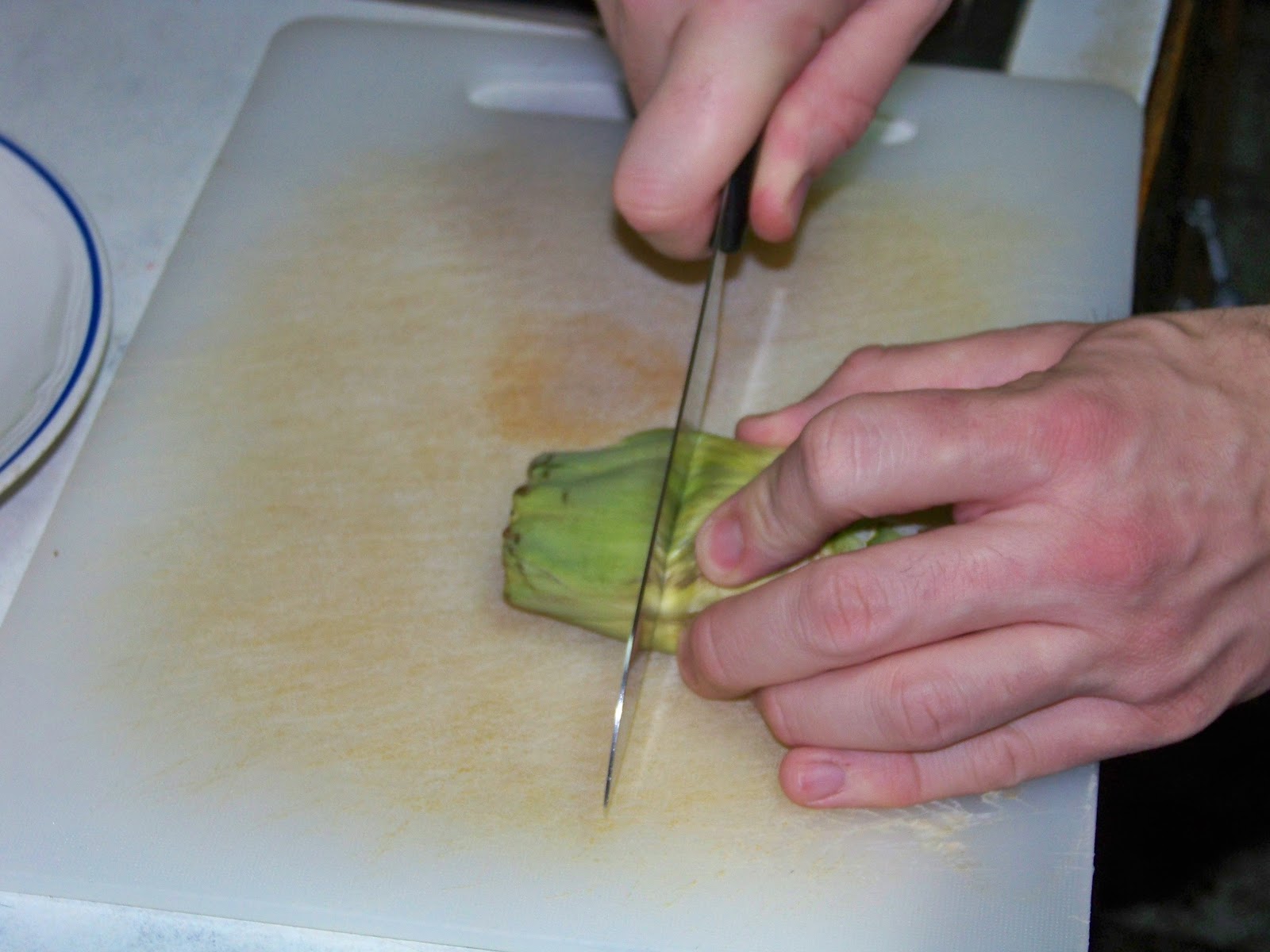
  2. Peel and dice the onion and carrots to approximately the same size.  Dice the pepper to the same size.  Peel the garlic, but do not chop it.  Prepare the artichokes by removing the tough petals, the stem, and the top part reserving only the hearts.  Chop them into small pieces.  
  3. Heat the oil over medium heat in the pot.  When it is ready add the garlic, onion, pepper, and carrots.  Cook until the ingredients start to soften a bit, about 10 minutes.  Then add the artichokes and cook for another five minutes.  
  4. Add the lentils, bay leaf, paprika and salt to the pot.  Cover with cold water and increase the heat to medium-high.  (If more water is needed later, you can add it.  I personally prefer thicker lentils.)  
  5. The lentils need to be kept at a steady, soft boil.  Keep an eye on the amount of water and taste for salt as you cook.  Stir the lentils often to avoid them sticking to the bottom of the pot.  The lentils will probably take about 45 minutes, but you should taste them first to see if they are soft.  
  6. If the salt is good and the lentils are soft your first pot of lentils is ready!  Let me know if you have any questions by writing me a comment below.  


Saturday, March 2, 2013

Pisto -- Garden fresh Spanish food


Of all of the traditional Spanish dishes, pisto has to be my absolute favorite.  I actually think I could eat it every day for breakfast, lunch, and dinner.  It is simple, yet exquisite and healthy, but flavorful.  Combine pisto with a poached or fried egg and you are instantly transported to a picturesque village in La Mancha.  It leaves you with a down-home, feel-good food high which can endure for days!  

So, what exactly is pisto?  Well, let me take care of that question.  Pisto comes from the Latin word pistus, which means smashed,as the Royal Academy of the Spanish Language states, and I translate.  They also define it as "a combination of fried ingredients including peppers, tomatoes, eggs, and onions or other foods which are chopped and scrambled."  Most pistos I have seen in Spain feature onions, peppers, tomato, and zucchini.  I have also seen many variations with eggplant or potatoes.  It is quite a versatile dish and very open to change in my opinion.  My version of pisto is made with onions, red and green peppers, zucchini, and tomatoes.  I top the dish with a fried or poached egg.

I know that many people in the States are looking for healthy, delicious alternatives to fat full options.  If you serve it right, this dish includes all the important food groups. I recommend eating the pisto topped with a poached or fried egg, or you could even scramble it together with a few eggs when you have finished.  Serve it with a good quality homemade or bakery style bread, none of that sandwich bread nonsense.  If you still have room for dessert, have some fruit and yogurt to complete the food pyramid.  

In my recipe below I show you how to make a simple and healthy pisto with ingredients that you will easily find in your garden.  I have to admit that normally when I cook I don't do exact measurements on anything, so I can't promise that the measurements I have provided are correct.  I did two things differently than normal.   in the photos you will see posted below.  I used red, yellow, and green bell peppers because they were on sale; and I accompanied my dish with poached eggs and a bit of spicy cod.  

Well, so as to not keep you waiting any longer.  I present you my recipe for pisto.  Please enjoy it and make it often.  Remember, it's healthy!

Ingredients

  • 1 large onion
  • 1 large green pepper
  • 1 large red pepper
  • 2 large zucchinis
  • 1 kg (around 2 lbs) tomatoes
  • 2 cloves of garlic (or more depending on your personal taste)
  • 1 tbsp. sweet Spanish paprika (make sure it is sweet, and Spanish if possible)
  • Thyme (optional, this is my addition, an authentic pisto does not feature thyme)
  • Salt 
  • Extra virgin olive oil

Equipment

  • 1 large pot
  • Cutting board
  • Large spoon
  • Bowls
  • Good chopping knife
Instructions
  1. Dice onion and peppers.  Peel the zucchinis and cut them into four pieces lengthwise.  Cut the seedy part out of the middle.  Then chop them the same size as the onion and peppers. 
  2. Bring a pot of water to a boil.  When it comes to a boil, add the a few of the tomatoes.  After a minute, remove them with a spoon and rinse them with cold water.  Repeat until all of the tomatoes have been blanched.  
  3. When all of the tomatoes have cooled.  Peel the skin and remove the seeds.  Then smash them a bit in a bowl.  
  4. Chop off the bottom ends of the cloves of garlic and peel them.  
  5. Heat the olive oil over medium heat in a large pot.  When heated, add the whole garlic and onions.  
  6. Stir for about a minute,  then add the peppers and cook for about 7 minutes.  
  7. Add the zucchini, a pinch of salt, paprika, and thyme.  (I always rub the thyme leaves a bit with my fingers as I remove them from the sprig)  
  8. Stir ingredients and continue cooking uncovered for 5 minutes. 
  9. Lower the heat and cover the pot.  Cook covered for about 20 minutes stirring occasionally.  (I have never actually timed this recipe.  I always taste as a cook, and from there I decided if it needs more salt, more time, etc.)
  10. When finished you can serve it as I like: topped with a fried egg, and accompanied by a good bread.


Tuesday, February 26, 2013

Tortilla de Alcachofas -- Artichoke Tortilla

I know what you might be thinking from the title, "mmmm, artichokes, like that spinach-artichoke dip that we eat as an appetizer in most American restaurants"  and, "tortilla, like the chips we dip into said starter."  Well, I have to say, "incorrect."  A tortilla in Spain has nothing to do with the tortilla you are used to seeing  as small chips or in flat, thin bread form used for tacos.  Today's lesson is about two of my favorite things mixed into one: Spanish tortillas and artichokes.

Tortilla in Spain refers to something similar to an omelette.  According to the Spanish Royal Academy, the institution responsible for regulating the Spanish language, the tortilla is a diminutive form of the word torta (a round cake).  The tortilla is defined and translated as "a round-shaped, fried mixture of beaten eggs and one or various other ingredients." The most famous tortilla in Spain is the tortilla española (or tortilla de patatas) which is a simple omelette made of eggs, potatoes, olive oil and salt.  These "Spanish omelettes" can also be filled with onions, peppers, chorizo, parsley, or various other ingredients.  The most common is the potato omelette made either with or without onions.  There are many other varieties of tortilla ranging from tuna or cod to zucchini or artichokes.  

The artichoke is frequently used in Mediterranean cuisine in a wide variety of dishes.  You can see it in its simplest form, used alone either boiled or fried, or mixed with other ingredients such as the tortilla that I am going to teach you to make today.  I think the fresh artichoke may be a bit rare in many Midwestern American kitchens.  I remember seeing its canned variety more than its fresh variety.  In my opinion, the preserved variety is very tasteless and industrial.  (I will save my ranting about using canned food for a later blog.)  Artichokes are a fountain of nutrition.  According to the United States Department of Agriculture, there are only 66 calories in each 100 grams of cooked, fresh artichokes.  It is very low in fat and high in fiber, folate, and vitamins C&K. I always use fresh artichokes.  At first they may seem difficult to cut with their bunch of thorny petals, but what lies beneath these hard, spiky petals is a delicious treasure.  


Now,  I will cut the chatter and get to the culinary instructions to help you uncover the hidden treasure that is the artichoke.  I am sure that when you uncover it you will enjoy this authentic Spanish dish.  ¡Buen provecho!

Equipment

  • Frying pan
  • Chopping board
  • Spatula
  • Plate
Ingredients
  • 6 artichokes
  • 4 - 5 eggs
  • 2 cloves of garlic
  • Olive oil
  • Salt
Instructions

Take the outer petals off until you notice that the bottom part of the petals becomes a yellow-green color and the bottoms are no longer tough.  After that, chop off the hard spiky tops of the petals and then cut the stem from the bottom.  I divided each artichoke into eight pieces, but I think it would have been better to cut them into even smaller pieces.  Then to finish with the artichokes I always put them in a bowl of water so they let out some of their dark color and do not change to brown.


Heat oil in pan over medium heat.  Lightly crack the cloves of garlic with the flat part of the knife and peel off the skin.  Fry the garlic on all sides until golden brown and remove it from the pan (this is supposed to give garlic flavor to the oil, but I don' know if it works so well).  


Now add the artichokes and a pinch of salt.  Cook them until they are softer, 7 - 8 minutes.  Put them on a plate lined with paper towels to drain the oil a bit. 


Heat a bit more oil in the frying pan.  Beat the eggs well and add salt.  Mix the cooked artichokes with the eggs.  Add the mixture to the same frying pan and wait for the tortilla to start forming.  When you see that it is quite done on the bottom, take a large plate and flip the omelette to cook the other side (this can be quite difficult sometimes).  When the tortilla is finished on both sides it is ready.  


Y ya está, it's finished!  I recommend eating it as a starter with a bit of bread or as a side dish (or main dish) for breakfast, lunch or dinner.  Whatever you do, please do not put ketchup on it!


Friday, February 22, 2013

Oro Líquido -- Liquid Gold

For me, butter and olive oil have a strong rivalry and they have always tried to compete for my love with their respective charming qualities.  I have to admit that I have had a love-hate relationships with these two fatty condiments throughout my life.  When I first tried olive oil many years ago I thought it was too oleaceous and bitter.  My relationship with butter started much earlier and I viewed it as banal and overrated.  Years later I got to know olive oil better and stopped spending time with butter.  I fell too much in love with olive oil and refused to give space in my refrigerator shelf to butter.  As I started experimenting more with Mediterranean food I realized I missed butter a tad bit.  So, to solve this problem I saved him some space in the fridge and now use him to make great American desserts such as apple pie. 

I am no nutritionist, but I do know one thing for sure: olive oil is healthier than butter.  As I finish my fourth year here in Spain I see myself adapting to the olive oil culture more and more every day.  I see new ways to use olive oil instead of butter, or better yet, ways many Spanish people have been eating it for years.  The important thing is to find a good tasting extra virgin olive oil to use for cold dishes, and a cheaper olive oil for frying.  I've made a short list of some ideas I've learned from friends and students.  I actually use many of them in my own cooking.  


Propositions

  • Toast with olive oil, sugar and cinnamon (one of my American/Spanish fusions)
  • Toast with olive oil and jam (photo below)
  • Oranges or tangerines mixed with a little olive oil and sugar.
  • Top mixed vegetables with a mix of minced garlic fried in olive oil and a bit of sweet paprika.  (Don't fry the garlic for too long.  You're looking for a pale golden color)
  • Boil potatoes and cauliflower and then top them with a good fresh extra virgin olive oil and a good vinegar (So simple, but so good!)


Toast with olive oil and sugar.  Toast with olive oil and strawberry jam.